ABOUT THE BOOK
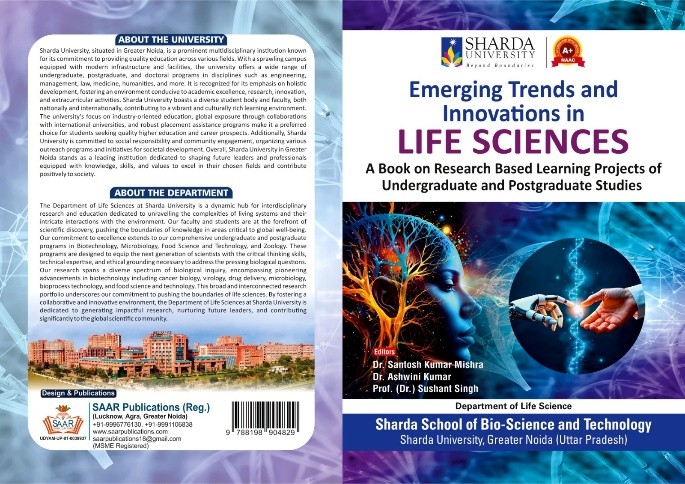
Title: Emerging Trends and Innovations in Life Sciences: A Book on Research-Based Learning Projects of Undergraduate and Postgraduate Studies
Editors: Dr. Santosh Kumar Mishra, Dr Ashwini Kumar & Prof. (Dr.) Sushant Singh
Published by: SAAR Publications [Reg.]
Publisher’s Address: A-09, Sita Ram Colony, Balkeshwar, Agra, Uttar Pradesh – 282004
Language: English
Pages: 458
Edition: July 2025
ISBN: 978-81-989048-2-9
DOI:10.21276/saar/9788198904829
Citation: Mishra, S. K., Kumar, A., & Singh, S. (2025). Emerging Trends and Innovations in Life Sciences: A Book on Research Based Learning Projects of Undergraduate and Postgraduate Studies. https://doi.org/10.21276/saar/9788198904829
Emerging Trends and Innovations in Life Sciences: A Book on Research-Based Learning Projects of Undergraduate and Postgraduate Studies
The 21st century has witnessed remarkable advancements in Life Sciences, opening new frontiers in health, environment, agriculture, and biotechnology. Central to this progress is the transformation of education systems that empower young minds to actively participate in solving real-world scientific challenges. The book, Emerging Trends and Innovations in Life Sciences is a significant stride toward bridging the gap between academic learning and practical application. This compilation showcases the Research-Based Learning (RBL) projects undertaken by undergraduate and postgraduate students of the Department of Life Sciences, Sharda School of Bioscience and Technology, Sharda University, Greater Noida, U.P., India. RBL has proven to be a transformative pedagogical approach that fosters critical thinking, curiosity, and hands-on experimentation—moving beyond routine learning to cultivate inquiry-driven exploration. In disciplines like life sciences, where observation, experimentation, and evidence-based reasoning are fundamental, such an approach is not only valuable but imperative. This book brings together a wide range of interdisciplinary research projects in areas including biotechnology, molecular biology, bioinformatics, microbiology, nanotechnology, environmental science, food science, and healthcare innovation. Each chapter reflects both scientific rigor and the potential for impactful contributions to sustainability, public health, and technological development. What sets this volume apart is its focus on the research journey itself—the process of ideation, experimentation, and problem-solving guided by dedicated faculty mentors. Their support has nurtured a culture of mentorship and collaborative learning, enriching students both academically and personally. This book serves as an inspiration for students to embrace research, a guide for educators to embed inquiry in curricula, and a glimpse for industry and academia into the creativity of young scientists
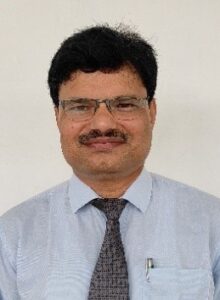
Dr. Santosh Kumar Mishra is working as an Associate Professor & HOD in the Department of Life Sciences. Dr. Mishra has completed his M.Tech.. in Biotechnology from the Institute of Engineering & Technology, Lucknow, U.P., and his Ph.D. research work from the Indian Institute of Technology, Roorkee. He has received his Ph.D. Degree from Dr. A.P.J. Abdul Kalam Technical University, Lucknow. He has more than 20 years of teaching, research, and academic administration experience. Before joining Sharda University, he was associated with IMS Engineering College, Ghaziabad. He has supervised 8 M. Tech students’ dissertation work in different areas of biological sciences. He has published 27 research publications in international peer-reviewed journals, 14 book chapters in edited books, and has also presented his work at various national and international conferences. Dr. Mishra is a dedicated and passionate teacher committed to research and innovation. He has rich experience in the NBA and NAAC accreditation processes and served as an IQAC member. Dr. Mishra has served as an Editorial Board Member & reviewer in prestigious international journals. He has also worked as Editor in Chief of a Bi-annual student magazine. Member Board of Studies, Dr. A.P.J. Abdul Kalam Technical University, Lucknow. He is a Life member of the Biotech Research Society, India (BRSI). He has also received the Excellence in Teaching award from the Society for Bioinformatics and Biological Sciences (SBBS) in recognition of outstanding scientific contribution in the field of Biotechnology for the year 2017.
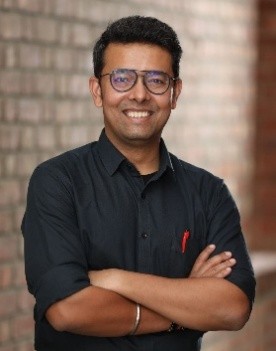
Dr Ashwini Kumar is presently working as an Assistant Professor in the Department of Life Sciences, Sharda School of Bioscience and Technology, Sharda University, Greater Noida, Uttar Pradesh. Previously, he has served as an Assistant Professor in the Biotechnology and Bioinformatics Area at NIIT University, Neemrana (Rajasthan), Department of Biotechnology at IMS Engineering College, Ghaziabad, and as a Lecturer in the Department of Biotechnology, National Institute of Technology, Raipur, Chhattisgarh. The central component of Dr Kumar’s research has been biomaterial science, specifically in the field of novel drug delivery systems. The target applications of his research are formulating non-invasive and minimally invasive drug delivery approaches for better results, both in terms of pharmaceutics and patient compliance. His interest also lies in the field of tissue engineering, diabetes, and drug discovery. He has authored 24 journal articles in national and international journals, 13 book chapters, and a book. He also holds a patent on his work from PhD. He has been invited as a speaker and jury member on various national scientific platforms. He is an Editor at Nature Scientific Reports, an Associate Editor for Frontiers in System Biology, Associate Editor for Frontiers in Endocrinology, Review Editor for Frontiers in Oncology (Section – Gastrointestinal Oncology), a guest editor of Frontiers in Medical Technology, and a reviewer of Frontiers in Pharmacology, Frontiers in Oncology, Food Hydrocolloids for Health (Elsevier), Cancer Reports (Wiley), Materials and Design (Elsevier), Redox Report (Taylor & Francis), and Diabetic Medicine (Wiley). He is a life member of the Asian Polymer Association

Prof. (Dr.) Sushant Singh is currently working as a Professor in the Department of Life Sciences at the Sharda School of Bio-Science & Technology, Sharda University. He earned his Ph.D. in Biotechnology from IIT Guwahati in July 2014 and has extensive postdoctoral research experience at leading institutions, including the University of Central Florida, Ohio State University, and the SBP Medical Discovery Institute in the USA. Dr. Singh’s impressive contributions to research include 14 patents (1 International and 13 National) and over 50 research articles published in peer-reviewed international journals. He has presented his work at more than 50 International and National conferences, frequently as a keynote speaker, and has received numerous accolades for his contributions. As an active reviewer for esteemed journals in Biotechnology, Nanotechnology, and Life Sciences, Dr. Singh is recognized for his critical insights and expertise. His research excellence is further highlighted by his success in securing funding as a Principal Investigator for SERB(SRG), MSME Idea Grant for Prototype Development, and Sharda University Research Seed Fund, a research project. Beyond his research achievements, Dr. Singh is deeply committed to fostering innovation and entrepreneurship. As a Member of the Innovation Ambassador at the Ministry of Education’s Innovation Cell (MIC), Government of India, he actively promotes entrepreneurial initiatives and innovative thinking in academia and beyond.
TABLE OF CONTENTS
| S. No. | Title and Authors | Page no. |
Advanced Materials for Diabetic Wound Healing: The Role of Cerium Oxide Nanoparticles Ishika Bansal, Jaspreet Kaur, Iram Jahan, Sushant Singh | 1 | |
ESKAPE Pathogens: Resistance Against Multiple Drugs and Its Cure Bishnupriya Sahoo, Dakmik Padung, Baba Ali Kachalla, Dr. Rashmi Prabha Singh | 26 | |
Incorporation of Malted Grains in Biscuit Production Alina Zaidi, Prachi Rajora, Abhinav Anand Singh, Sagar Tiwari, Ranjana Pande | 39 | |
Cellulose and Hemicellulose from Sugarcane Waste Bagasse: Biomolecular Significance and Sustainable Applications Chehak Joshi, Anshika Sharma, Iram Jahan, Sushant Singh | 56 | |
Computational Approaches for Targeting Glycogen Synthase Kinase in Diabetes Abubakar Idris Shehu, Mudra Sikenis, Subhabrata Kar | 84 | |
Staphylococcus aureus infection and its impact on human intestine Bhavya Rani, Bennet Angel, Annette Angel, Vinod Joshi | 95 | |
Algal Bioreactor of Autotrophic and Mixotrophic Biomass Productions Divya Sharma, Ayushi Sharma, Neeraj Agarwal, Nupur | 107 | |
Review On Helicobacter pylori: Virulence Factors Shamsuddeen Muhammad Sagir, Rashmi Prabha Singh | 129 | |
Jackfruit Seed-Millet Milk Blend: A New Frontier in Beverage Innovation Gopika R Pillai, Ranjana Pande | 144 | |
Meta-Analysis of Prognostic Markers of Breast Cancer and Current Treatment Strategies in India Harshita, Bennet Angel, Annette Angel, Vinod Joshi, | 155 | |
Cerium Oxide Nanoparticles: Characterization and Their Applications Gigyasa, Kartavya Rout, Iqra Jamsehd, Vikash Lodhi, Santosh Kumar Mishra, Sushant Singh | 166 | |
Bacterial Applications in Heavy Metal Detoxification for Cleaner Water Systems Divya Sharma, Aditi Singh, Nithika S Ramesh, Pungming Singhi, Mili Mili, Neeraj Agarwal, Soumya Pandit, Nupur | 181 | |
Role of Anaerobic Respiration Derived Lactic Acid in Severing Malignant Breast Cells Hritik Chaudhary, Siddhant Mavi, Vinod Joshi, Bennet Angel, Annette Angel | 199 | |
Jal Jeevan Mission and Jal Shakti Abhiyan: A Comparative Study on Community Awareness and Knowledge about Water Contamination and Conservation Hanshika Saini, Sujata Pandit Sharma
| 216 | |
A Study on Epstein–Barr Virus: Host Interaction, Persistence Mechanisms, and Clinical Implications Lunjapikai Haokip, Annette Angel, Vinod Joshi, Bennet Angel | 250 | |
Iron Oxide Nanoparticles: Synthesis, Characterization and Application in Biofuel Industry Priyanshu Ranjan, Shaiba Naaz, Kumari Durga, Latasha Singh, Preeti Pandey, Mohit Kumar | 267 | |
Sensors for Smart Food Packaging: A Review Arya, Anushka Pandey, Anamta Bi, Gayatri Kaul, Hanshika Saini, Anamika Mehta | 281 | |
Role of Peptides as Therapeutics for The Treatment of Neurodegenerative Diseases Baba Kalli Sufama, Mudra Sikenis, Subhabrata Kar | 291 | |
Recent update on Epstein-Barr Virus Proteins and its association with Various Oral Malignancies Megha Kumari, Prity Kumari, Annette Angel, Vinod Joshi, Bennet Angel | 305 | |
Role of metabolites in colorectal cancer Tanishka, Jitendra Kumar, Soumi Sadhu, Binayak Kumar, Nupur | 321 | |
BZLF1: The Molecular Switch Of EBV Reactivation And Its Role In Disease Progression Kuppa Sree Vagdevi, Annette Angel, Vinod Joshi, Bennet Angel | 341 | |
Akt-mTOR Pathway: Complex Network for Skeletal Muscle Mass Regulation Garima Gautam, Deepakshi, Adeeba Khan, Priyanshi, Mahak Gupta, Vikas Dutt | 355 | |
Millet Study on Nutritional Profiling and Consumer acceptability of Millet Based Energy Bar Riya Thakur, Ranjana Pande | 367 | |
Identification of Plant Based Drugs For Management Of Migraine Using In Silico Tools Jharna Deep, Raisa Rishu and Dr. Smita Jain | 376 | |
An Elaborate Comparative Study of Natural Organic Himalayan Honey and Commercial Brand Honey And The Physiological And Quality Aspects With Respect To Analytical Approach Of Testing And Proximate Evaluation. Ritika Chaurasiyaa, Piyush Jai Mallick, Abhinav Nair | 385 | |
Recent Advancements On Production of Biohydrogen Using Microalgae Arnab Dey, Anjali Rawal, Mohini Singh | 401 | |
Kodo and Pearl Millet: Ancient Grains for Modern Nutrition Amrita Majumdar, Sneha Pant, Anargha Saha, Savita Rani | 412 | |
Molecular Characterization and In-silico Analysis of Coat Protein Gene of Carlavirus Infecting Allium Crops Vaishnavi Jhaa, Mridusmita Paul, and Dr. Vineeta Yadav | 430 | |
Microbial production of alkaline protease and its industrial applications Oinam Bidyarani Devi, Ali Jibril Baba, Mohit Kumar, Sushant Singh, Santosh Kumar Mishra | 441 |