
ABOUT THE BOOK
Editors: Dr Dayanand Sharma and Dr Saicharan Vasala
Published by: SAAR Publications (Reg.)
Language: English
Pages: 129
Edition: November 2025
ISBN: 978-81-993659-7-1
DOI:
Citation:
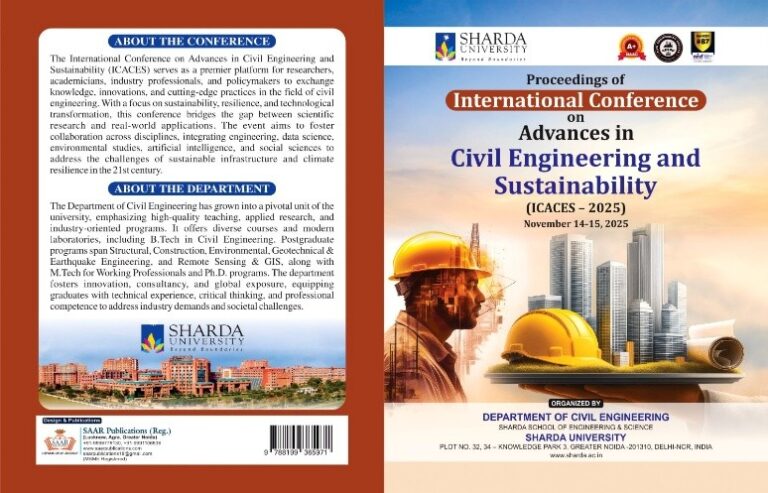
This volume presents the selected research contributions from the International Conference on Advances in Civil Engineering and Sustainability (ICACES-2025), encompassing cutting-edge developments in sustainable, resilient, and intelligent civil engineering systems. The book brings together keynote lectures and peer-reviewed papers addressing critical challenges related to climate change, water resources, sustainable materials, circular economy, structural health monitoring, environmental remediation, and smart infrastructure planning. Contributions span experimental, analytical, numerical, and data-driven approaches, including AI-based optimization, remote sensing and GIS applications, low-carbon construction materials, waste valorisation, flood and hydrological modelling, and resilient infrastructure design. Collectively, the chapters highlight innovative methodologies and practical solutions aimed at enhancing sustainability, resilience, and efficiency in the built environment. This book serves as a valuable reference for researchers, practitioners, policymakers, and graduate students seeking contemporary insights and interdisciplinary perspectives in civil engineering and sustainability research.
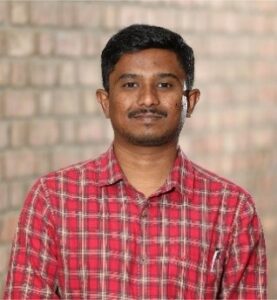
Dr. Vasala Saicharan is an Assistant Professor in the Department of Civil Engineering at Sharda University, India, and serves as an Editor of the Proceedings of the International Conference on Advances in Civil Engineering and Sustainability (ICACES-2025). His research expertise lies in sustainable water resources management, with a strong focus on the application of Remote Sensing, Geographic Information Systems (GIS), Machine Learning, and Hydroinformatics to address pressing challenges related to groundwater modelling, agricultural water footprints, drought assessment, and climate variability. Dr. Saicharan has actively contributed to interdisciplinary research through peer-reviewed journal publications, book chapters, and numerous international conference presentations. His research excellence has been recognised through prestigious national and international grants, including SERB-ITS (DST, India), AGU Travel Grants, BUCEA China Travel grant, and IEEE GRSS grants. He holds a Ph.D. in Remote sensing and GIS from the National Institute of Technology Karnataka (NITK), India, and an M.Tech in Geo-Informatics and Surveying Technology from JNTU Hyderabad. Beyond research, Dr. Saicharan plays an active leadership role in professional bodies such as IEEE GRSS, ISPRS-SC, and AGU-H3S, contributing to conference organisation, peer review, and mentoring young researchers.

Dr. Dayanand Sharma is an Assistant Professor in the Department of Civil Engineering at Sharda University, Greater Noida, India. He holds a PhD in Environmental Engineering from Sardar Vallabhbhai National Institute of Technology (SVNIT), Surat, and has over 15 years of combined experience in teaching, research, and professional practice. He has also served as a Postdoctoral Research Fellow at the Agricultural Research Organization (ARO), Ministry of Agriculture and Rural Development, Israel. Dr. Sharma’s research expertise spans solid waste management, composting and vermicomposting, refuse-derived fuel utilization, hydrothermal degradation, wastewater treatment technologies, and sustainable construction materials. He has authored more than 30 peer-reviewed research articles in high-impact international journals and has contributed extensively to edited volumes published by leading global publishers such as Elsevier and Woodhead Publishing. He is a recipient of multiple Best Paper Awards at international conferences and holds granted patents and design registrations related to waste processing technologies. Dr. Sharma has successfully led sponsored research projects and consultancies funded by government agencies, industry partners, and regulatory bodies
TABLE OF CONTENTS
S.No. | Title of Abstract & Author(s) | Page No. |
1 | Circular Economy-Inspired Waste-to-Energy Systems: Transforming Research Innovations into Scalable Market Solutions – Stephen James Ijimdiya | 6 |
2 | Rethinking Water Quality Indexing under Degraded Water Systems and Climate Pressures – Joy Tuoyo Adu | 7 |
3 | Effects of Land Use Land Cover on Precipitation and River Discharge in the Saligeru Catchment, Andhra Pradesh – Dinagarapandi Pandi | 8 |
4 | Understanding the Damage Mechanism in Concrete Structure Using EMI Response of Embedded PZT Sensor under Different Mechanical Loading Conditions – Ramesh Gomasa | 9 |
5 | 10 | |
6 | Reusing Platinum Slag Waste in Paving Blocks Production towards a Circular Economy: Influence on Performance and Sustainability – Mustapha Bamidele Jaji | 11 |
7 | Effect of Utilisation of Limestone Calcined Clay as a Partial Substitute for Portland Cement in Paving Block Production on the Embodied Energy and Carbon Output – Mustapha Jaji | 12 |
8 | Corrosion Assessment and Control Techniques in RCC Structures Using Piezo Sensor – Ranveer Sahu | 14 |
9 | Circular Valorization of Sugarcane Wastes: Enhancing Compost Quality through Rotary Drum Technology – Asava Suraj | 16 |
10 | Eco-Efficient Brick Firing: Assessing Refuse Derived Fuel as a Sustainable Replacement of Coal – Utsav Sharma | 18 |
11 | Assessment of Hybrid Treatment Systems for Sustainable Greywater Reuse – Durgesh Kumar | 20 |
12 | Reason, Method and Impact of Dampness on Residential Buildings in Urban Area – Deepesh Kumar | 21 |
13 | Enhanced Biogas Production through Co-Digestion of Dry Leaves and Organic Wastes – Zodinsanga Vanchhawng | 22 |
14 | Quantitative Evaluation of Biofilm Carrier Systems for Minimizing Excess Biomass Yield in Municipal Wastewater Treatment – Manish Kumar | 24 |
15 | Assessment of Municipal Solid Waste Management Practices and Sustainable Utilization of Incineration Ash in Concrete – Ritu Sharma | 26 |
16 | Green Concrete Innovations: SEM, XRD, and XRF Characterization of Fly Ash, MSWIBA, and Waste Glass Powder for Sustainable Concrete – Ritu Sharma | 27 |
17 | Modeling Forest Ecosystem Changes in the West Garo Hills (2015–2025) Using Multi-Temporal Sentinel-2 Imagery and Random Forest Classification – Rakabandera Ch. Marak | 28 |
18 | Utilisation of Secondary Sludge from Wastewater Treatment Plants as a Partial Replacement for Cement in Concrete – Syed Musa Jeelani | 30 |
19 | Sustainable Damage Monitoring in Reinforced Concrete Incorporating Refuse Derived Fuel Fly Ash via Piezoelectric Sensing Technique – Jitendra Kumar | 31 |
20 | Early-Age Hydration Monitoring of Mortar Made with Rice Husk Ash Using Piezoelectric Sensor Based EMI Technique – Dheeraj Sharma | 33 |
21 | Innovative Pathways for Garden Waste Management: A Review Towards Circular Sustainability – Hrishikesh Shivam | 35 |
22 | Resource Recovery from Printed Circuit Boards Using Subcritical Water: A Sustainable Alternative to Conventional Leaching Methods – Ousmane Lass Donzo | 34 |
23 | Designing Climate-Resilient Multiple-Use Water Services for Rural Water Security in Nepal – Narayan Singh Khawas | 35 |
24 | Land Use and Land Cover Changes Detection in Ghaziabad, Noida, and Dadri Regions Using Remote Sensing and GIS Techniques – Prachi | 37 |
25 | Integrating BIM with Modular Construction: Challenges and Strategies to Enhance Industry Efficiency – Harshpreet Singh | 39 |
26 | Numerical and Experimental Study of Reinforced Concrete and Engineering Cementitious Composite (ECC) Jacketing on Pre-Damaged Columns under Axial Load – Khushi Sharma | 40 |
27 | Municipal Solid Waste Management in India with a Focus on Arunachal Pradesh: Challenges, Innovations, and Policy Pathways – Tsering Drema Rongradu | 42 |
28 | Noise Data Handling and Correlation Analysis for Urban Pollution Control and Environmental Monitoring – Jini Sunil kumar | 44 |
29 | Enhancing the Seismic Capacity of Existing Structures Using Geopolymer and GFRP Materials for Retrofitting: A Systematic Review – Rahulkumar Sharma | 46 |
30 | Risk Identification and Assessment in Infrastructure Projects within Maiduguri Metropolitan Council – Ali Fannami Kambar | 47 |
31 | Performance Evaluation of Polymer Matrix Composite Material on Reinforced Concrete Beam – Akanksha Kishor Nakate | 48 |
32 | Optimizing Self-Compacting Concrete (SCC) Mix Using Artificial Intelligence for Low-Carbon Construction – Deepti Singh | 49 |
33 | Sulfate-Radical-Mediated Decolorization of Azo Dye via CuO-Activated PMS Catalysis – Hetvi Dilip Burkhawala | 50 |
34 | Mechanistic and Multivariate Optimization of RR120 Decolorization via UV-Activated H₂O₂: Integrated Process Evaluation and RSM Optimization – Abhipsa R. Makwana | 51 |
35 | Increasing Trends of Extremely Heavy Rainfall Events and Their Impact on Severity Floods in India – Sanwar Mal | 52 |
36 | Introduction to Bio-Brick Machine – Kedar Audumbar Sudake | 53 |
37 | Use of Neem Biochar in Concrete – Bishnudev Yadav | 54 |
38 | Uncertainty of Flow Duration Curves – Sanjay Kumar | 55 |
39 | Satellite-Based Assessment of Diwali-Induced Air Pollution Dynamics in Gurugram, India – Ashwani Singh | 57 |
40 | Design and Analysis of Hollow Ferrocement Blocks for Weight Reduction – Tejashri Somnath Thite | 58 |
41 | Strengthening and Retrofitting of Beam by Using Ferrocement – Snehal Mohan Patil | 60 |
42 | Comparative Study of Embedded, Surface-Bonded, Jacketted, and Non-Bonded Piezo Sensor Configurations in EMI-Based Structural Health Monitoring – Jai Srivastava | 61 |
43 | Seismic Analysis of a Multi-Storey Building (G+5) with Floating Columns Using ETABS – Tasaduq Rouff | 62 |
44 | Performance Evaluation of E-Waste Concrete Using the Electro-Mechanical Impedance Technique – Gaurav Kumar | 63 |
45 | Treatment of Leather Industry Wastewater Using Advanced Available Technologies and Analysis of Various Parameters – Anjana Kishore | 64 |
46 | Role of Insolvency and Bankruptcy Code (IBC) in Sustainability of Institutional Finance in the Indian Context – Rahul Gupta | 66 |
47 | Hydraulic Design of Small Hydro-Power Plant – Hitesh Kumar | 67 |
48 | Development of Regional Flood Frequency Relationships using L-moments for Gauged Catchments of South Brahmaputra Subzone-2(b) of India – Chandan K. Mishra | 68 |
49 | Delineation of Rainwater Harvesting Potential Zones in a Tropical Semi-Arid Basin Using an Integrated SWAT-MCDM Framework: A Case Study of the Daund Watershed, Pune – Saidutta Mohanty | 69 |
50 | Design Flood Estimation Under Climate Change Projections for Khadakhai Dam – J.P. Patra | 71 |
51 | Probabilistic and Deterministic Approaches for Design Flood Estimation for Indian Practitioners – Rakesh Kumar | 73 |
52 | Experimental study of Compressive Strength of Concrete with Different Grades – Deepak Kumar Dwivedi | 74 |
53 | Behaviour of RC Beams under Drop Weight Impact: Insight through Finite Element Analysis – Kesang Lamu Bhutia | 76 |
54 | Comparative Study of Recycled Coarse Aggregate Concrete with Conventional Concrete – Vishal Kumar Patel | 77 |
55 | Innovative Physicochemical and Biological Strategies for Textile Wastewater Remediation and Performance Evaluation – Beauty Kumari | 78 |
56 | Enhancement of Bearing Capacity of Open Foundation on Geogrid Reinforced Soil Using Finite Element Method – Maharabam Nirola | 79 |
57 | Envisioning the Amphibious Structures: An Adaptive Solution to Flood Resilience – Goutham Kattekola | 80 |
58 | Assessment of Green Building Indicators Addressing Sustainability and Life-Cycle Parameters in Indian Residential Developments – Geetor Saydee | 81 |
59 | Analysis and Design of Radiant Cooling System – Md. Raja | 83 |
60 | Analyzing the Effects of Wind Loads on Structures in Zone IV of India – D. Jah Bestman Jr. | 84 |
61 | Design and Planning of Wastewater Treatment Plant – Sandeep Chaudhary | 85 |
62 | Modern Earthing Systems for Buildings – Umeh Andy Chibuike | 86 |
63 | Development of ANN Model for the Prediction of Discharge Coefficient of a Rectangular Labyrinth Side Weir – Mohd Amir | 87 |
64 | Construction and Estimation of Hospital Building – Krishna Kumar Yadav | 88 |
65 | Biogas Potential of Indian Organic Wastes: Technologies, Challenges, and Future Prospects – Goojha Pravaj Raja Tohandas | 89 |
66 | Graphene-Infused Epoxy Adhesive Effect on Flexural Behaviour of CFRP-Strengthened RC Beam – Solmon Sharma | 90 |
67 | Design & Analysis of G+6 Residential multi-storey building – Naveen Vishwakarma | 91 |