ABOUT THE BOOK
Title: Academic Integrity and AI: Challenges and Opportunities in Higher Education
Editors: Dr. Jyotsna Kohli, Ms. Bhavna Aggarwal, Ms. Sakshi Rathi
Published by: SAAR Publications [Reg.]
Language: English
Pages: 148
Edition: 2025
ISBN: 978-81-990154-4-9
DOI: 10.21276/saar/978819901544910.21276/saar/9788199015449
Citation:Kohli, J, Aggarwal, B & Rathi, S 2025, Academic Integrity and AI: Challenges and Opportunities in Higher Education, SAAR Publications. https://doi.org/10.21276/saar/9788199015449
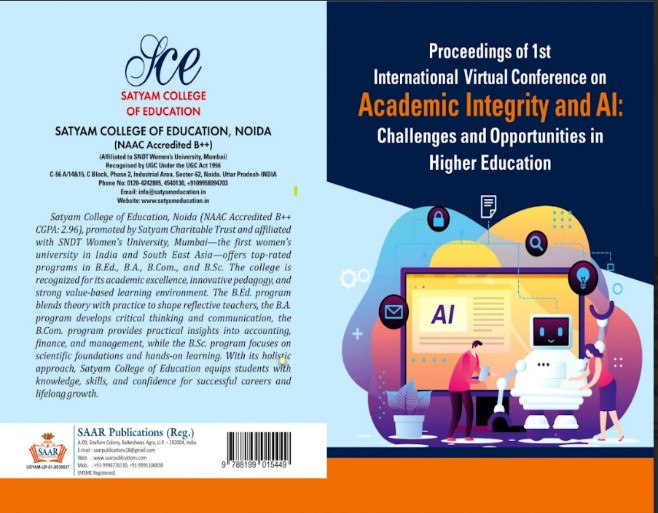
The rapid growth of Artificial Intelligence (AI) is transforming higher education, creating new opportunities and ethical challenges. The conference theme, “Academic Integrity and AI: Challenges and Opportunities in Higher Education,” highlights the need to harness AI’s potential responsibly. While AI supports personalized learning, research, and innovation, it also raises concerns about originality, authenticity, and ethical use.
In line with the National Education Policy (NEP) 2020, which promotes technology-enabled and value-based education, the conference explores key areas such as the paradigm shift in education with AI, opportunities and challenges for teachers, AI for inclusive and ethical education, redefining teaching–learning practices, and plagiarism in the age of generative AI. This volume brings together diverse insights and case studies that encourage responsible use of AI in academia. It aims to guide educators, researchers, and policymakers in building a future where innovation and integrity coexist harmoniously

Dr. Jyotsna Kohli is a distinguished academician and researcher with over 16 years of experience in Chemistry, Science Education, and Pedagogy. She was awarded the Senior Research Fellowship (SRF) by the Council of Scientific and Industrial Research (CSIR), New Delhi, in recognition of her research excellence. Her expertise lies in Environmental Education and Science Pedagogy, integrating chemistry concepts to enhance understanding of the natural world. She has 12 research publications, including four in reputed international journals, and is the author of ‘Environment & Ecology’ (Pearson, 2014) book.
Dr. Kohli’s work emphasizes inquiry-based learning, conceptual clarity, and the role of science in promoting sustainability and innovation. A passionate educator, she continues to inspire students to think critically, explore creatively, and act responsibly

Ms. Bhavna Aggarwal is an experienced Teacher Educator with over 18 years of academic and professional experience across reputed institutions in Delhi/NCR, including Bareilly College, IME, Mewar Institute, and Krishna College of Science & Technology. She is UGC-NET qualified and a Gold Medalist in M.A. (History), with research papers presented at national and international conferences and multiple publications to her credit. A committed environmentalist, she has designed the “CHETNA” course under the PM Usha Meru category and has been awarded a Mentor Certificate for her contribution to an NPTEL course, reflecting her dedication to innovation, mentorship, and sustainable education

Ms. Sakshi Rathi is an Assistant Professor at Satyam College of Education, Noida, and a Visiting Fellow at NIICE, Nepal. Her research focuses on International Relations, particularly the geopolitical dynamics among India, Nepal, and China in South Asia. She is currently pursuing a PhD in Political Science and Public Administration at Banasthali Vidyapith, Rajasthan. She has qualified the UGC-NET (Political Science) and holds two years of teaching experience
TABLE OF CONTENTS
| S.No. | Content | Page No.
|
| Chapter 1. प्रभावी शिक्षण-अधिगम प्रक्रिया एवं शिक्षकों की सुरक्षा – असुरक्षा की भावनाः चुनौतियाँ और अवसर | 1 | |
| 1 | सुरक्षा – असुरक्षा की भावना | 2 |
| 1.1 | शिक्षकों के लिए चुनौतियाँ | 5 |
| 1.2 | अवसर | 5 |
| Chapter 2. AI Tools for Teachers: Opportunities and Challenges | 6 | |
| 1. | Introduction | 7 |
| 2. | Understanding AI in Education | 8 |
| 3. | Opportunities of AI Tools for Teachers | 10 |
| 4. | Challenges and Concern | 13 |
| 5. | Ethical Policy and Considerations | 16 |
| 6. | Conclusion | 17 |
Chapter 3. Bridging the AI Literacy Gap: A Critical Study of Teachers’ Readiness and Training Needs | 19 | |
| 1. | Introduction | 20 |
| 2. | Understanding AI Literacy in Education | 21 |
| 3. | Teachers’ Readiness: Current Trends and Gaps | 22 |
| 4. | Case Studies | 23 |
| 5. | Key Training Needs Identified | 25 |
| 6. | Bridging The Gap: Recommendations | 26 |
| 7. | Conclusion | 28 |
| Chapter 4. Academic Integrity and AI: Challenges and Opportunities in Higher Education | 30 | |
| 1. | Introduction | 31 |
| 2. | How AI is used in higher education | 32 |
| 3. | Challenges and risks of artificial intelligence in higher education | 34 |
| 4. | Conclusion | 36 |
Chapter 5. Higher Education and Artificial Intelligence: Challenges and Opportunities for Professors | 38 | |
| 1. | Introduction | 39 |
| 2. | Review of Literature | 40 |
| 3. | Conclusion | 43 |
| Chapter 6. Paradigm Shift in Education with AI-Artificial Intelligence | 46 | |
| 1. | Introduction | 47 |
| 2. | Contemporary Education and Role of Artificial Intelligence | 48 |
| 3. | Meaning & Operational Definition of Important Terms | 50 |
| 4. | Review of Related Literature | 50 |
| 5. | Discussion | 51 |
| 6. | Conclusion | 54 |
Chapter 7. The Editor’s Edge: Comparing Human Expertise and AI Efficiency in Academic Writing | 56 | |
| 1. | Introduction | 57 |
| 2. | Literature Review | 58 |
| 3. | Research Methodology | 59 |
| 4. | Results | 63 |
| 5. | Discussion | 64 |
| 6. | Conclusion | 65 |
| Chapter 8. Paradigm Shift in Teaching and Research in the AI Era | 67 | |
| 1. | Introduction | 67 |
| 2. | AI as a partner in teaching: | 68 |
| 3. | AI as a partner in learning | 70 |
| 4. | AI and research | 71 |
| 5. | Ethical Concerns: | 72 |
| 6. | Looking Ahead | 73 |
| 7. | Conclusion | 74 |
Chapter 9. AI-Powered Personalization in Educational Marketing: Enhancing Student Enrolment Strategies in Higher Education Institutions | 77 | |
| 1. | Introduction | 78 |
| 2. | Artificial Intelligence in Educational Marketing | 79 |
| 3. | Benefits of Artificial intelligence in Educational Marketing | 81 |
| 4. | Ethical Considerations and Challenges | 82 |
| 5. | Case Studies and Industrial Practices | 84 |
| 6. | Strategic Recommendations | 85 |
| Chapter 10. AI-powered Instruction: Redefining the Role of the Teacher | 90 | |
| 1. | Introduction | 91 |
| 2. | Objectives of the Study | 91 |
| 3. | Methodology | 91 |
| 4. | Redefining the Role of the Teacher | 92 |
| 5. | AI Powered Tools and Platforms | 93 |
| 6. | Why Should AI & Teachers Work Together? | 96 |
| 7. | AI-assisted Teachers as Tech Guides and Mentors | 97 |
| 8. | AI’s Worldwide Applications In Redefining Teachers’ Roles | 98 |
| 9. | Advantages of AI Powered Instructions | 99 |
| 10. | Disadvantages of AI Powered Instructions | 100 |
| 11. | Suggestions and Future Directions | 101 |
| 12. | Conclusion | 103 |
Chapter 11: Academic Integrity and Al: Challenges and Opportunities in Higher Education | 105 | |
| 1. | Introduction | 106 |
| 2. | Paradigm Shift in Education with AI | 107 |
| 3. | Opportunities and Challenges for Teachers with AI | 108 |
| 4. | Bridging the Gap | 110 |
| Chapter 12: Generative AI and Academic Integrity: Boon, Bane or Both? | 117 | |
| 1. | Introduction | 118 |
| 2. | What is Generative AI? | 119 |
| 3. | What is Academic Integrity? | 119 |
| 4. | The Generative AI-Academic Integrity Interface | 120 |
| 5. | Generative AI as an Academic Tool: Potential Benefits (The Boon) | 121 |
| 6. | Generative AI’s Impact on Academic Integrity: Risks and Challenges (The Bane) | 122 |
| 7. | Solutions to Address Academic Integrity Challenges in the Age of AI | 123 |
| 8. | Strategies for Upholding Academic Integrity with Generative AI | 124 |
| 9. | Conclusion | 125 |
| 10. | Recommendations | 126 |
| Chapter 13: Opportunities and Challenges for Teachers with Artificial Intelligence | 129 | |
| 1. | Introduction | 130 |
| 2. | Literature Review | 130 |
| 3. | Opportunities for Teacher | 131 |
| 4. | Challenges for Teachers | 132 |
| 5. | Discussion | 133 |
| 6. | Implications for Practice | 134 |
| 7. | Conclusion | 135 |