ABOUT THE BOOK
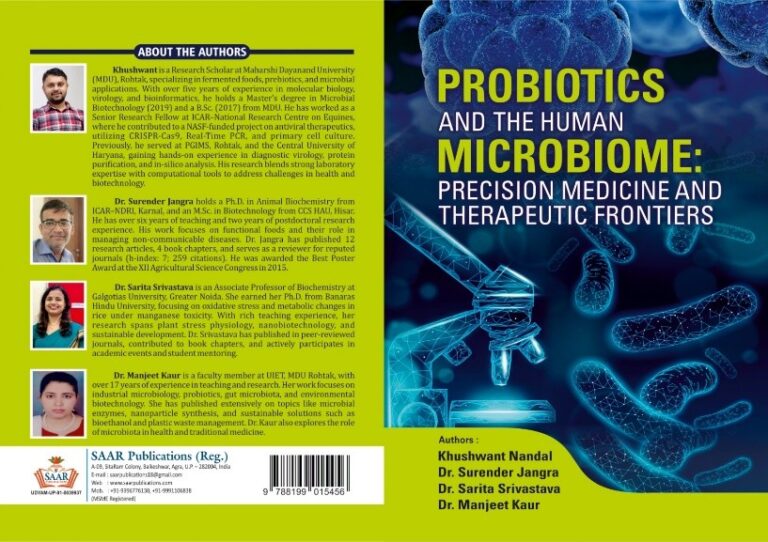
Title: Probiotics and the Human Microbiome: Precision Medicine and Therapeutic Frontiers
Editors: Khushwant Nandal, Dr. Surender Jangra, Dr. Sarita Srivastava, Dr. Manjeet Kaur
Published by: SAAR Publications [Reg.]
Publisher’s Address: A-09, Sita Ram Colony, Balkeshwar, Agra, Uttar Pradesh – 282004
Language: English
Pages: 270
Edition: July 2025
ISBN: 978-81-990154-5-6
DOI: 10.21276/saar/9788199015456
Citation: Nandal, K., Jangra, S., Srivastava, S., & Kaur, M. (2025). Probiotics and the Human Microbiome: Precision Medicine and Therapeutic Frontiers. https://doi.org/10.21276/saar/9788199015456
In an era where the intricacies of human health are increasingly illuminated through the lens of microscopic ecosystems, the human microbiome stands as a profound testament to our symbiotic existence with trillions of microorganisms. Often dubbed the “forgotten organ” or “second genome,” this dynamic community of bacteria, viruses, fungi, and archaea not only inhabits our bodies but profoundly shapes our physiology, from digestion and immunity to metabolism and even mental well-being. Disruptions in this delicate balance, known as dysbiosis, have been implicated in a cascade of modern ailments, including obesity, autoimmune diseases, neurological disorders, and more. Yet, within this complexity lies immense therapeutic promise: probiotics, beneficial microbes capable of restoring harmony and unlocking personalized health interventions. This book, Probiotics and the Human Microbiome: Precision Medicine and Therapeutic Frontiers, emerges from a convergence of cutting-edge research and clinical insights, aiming to bridge the gap between foundational science and practical applications. Drawing from diverse fields such as microbiology, immunology, genomics, and clinical medicine, it seeks to unravel the structure, function, and diversity of the human microbiome across body sites, while exploring the factors that influence it, the interactions that sustain it, and the consequences of its imbalance. We delve into the mechanisms by which probiotics combat dysbiosis, highlighting their roles in immune modulation, barrier integrity, and disease prevention. Advanced tools like metagenomics, metabolomics, and organoid models are discussed, alongside emerging strategies such as next-generation probiotics and fecal microbiota transplantation. The journey of writing this volume was inspired by the rapid evolution of microbiome science, driven by technological advancements that have transformed our understanding from vague associations to precise, actionable insights. It is particularly timely in the era of precision medicine, where tailoring therapies to individual microbial profiles could revolutionize disease management ranging from inflammatory bowel diseases to neurological conditions. However, challenges persist, including interindividual variability, regulatory hurdles, and the need for rigorous longitudinal studies. This book addresses these challenges, offering a roadmap for future directions, including underexplored niches like the placental microbiome and personalized microbial interventions. Intended for researchers, clinicians, students, and health enthusiasts alike, these pages invite you to explore the frontiers of microbiome therapeutics. May this work spark curiosity, foster innovation, and contribute to a healthier future where we harness our inner ecosystems to advance human well-being. With gratitude to the scientific community whose discoveries continue to light the path

Khushwant is a Research Scholar at Maharshi Dayanand University (MDU), Rohtak, specializing in fermented foods, prebiotics, and microbial applications. With over five years of experience in molecular biology, virology, and bioinformatics, he holds a Master’s degree in Microbial Biotechnology (2019) and a B.Sc. (2017) from MDU. He has worked as a Senior Research Fellow at ICAR–National Research Centre on Equines, where he contributed to a NASF-funded project on antiviral therapeutics, utilizing CRISPR-Cas9, Real-Time PCR, and primary cell culture. Previously, he served at PGIMS, Rohtak and the Central University of Haryana, gaining hands-on experience in diagnostic virology, protein purification, and in-silico analysis. His research blends strong laboratory expertise with computational tools to address challenges in health and biotechnology.

Dr. Surender Jangra holds a Ph.D. in Animal Biochemistry from ICAR–NDRI, Karnal, and an M.Sc. in Biotechnology from CCS HAU, Hisar. He has over six years of teaching and two years of postdoctoral research experience. His work focuses on functional foods and their role in managing non-communicable diseases. Dr. Jangra has published 12 research articles, 4 book chapters, and serves as a reviewer for reputed journals (h-index: 7; 259 citations). He was awarded the Best Poster Award at the XII Agricultural Science Congress in 2015.

Dr. Sarita Srivastava is an Associate Professor of Biochemistry at Galgotias University, Greater Noida. She earned her Ph.D. from Banaras Hindu University, focusing on oxidative stress and metabolic changes in rice under manganese toxicity. With rich teaching experience, her research spans plant stress physiology, nanobiotechnology, and sustainable development. Dr. Srivastava has published in peer-reviewed journals, contributed to book chapters, and actively participates in academic events and student mentoring
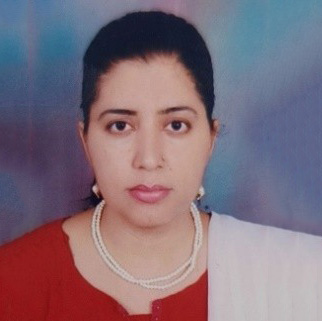
Dr. Manjeet Kaur is a faculty member at UIET, MDU Rohtak, with over 17 years of experience in teaching and research. Her work focuses on industrial microbiology, probiotics, gut microbiota, and environmental biotechnology. She has published extensively on topics like microbial enzymes, nanoparticle synthesis, and sustainable solutions such as bioethanol and plastic waste management. Dr. Kaur also explores the role of microbiota in health and traditional medicine
TABLE OF CONTENTS
| S.No. | Chapter 1. Unravelling Structure, Function and Diversity of Human Microbiome | Page No. |
|---|---|---|
| 1.0 | Abstract | 1 |
| 1.1 | Introduction | 1 |
| 1.2 | Composition and Diversity of Human Microbiomes | 4 |
| 1.3 | Factors Affecting Microbiome | 6 |
| 1.4 | Microbial Interactions | 7 |
| 1.4.1 | Microbial Interactions within Microbiome | 7 |
| 1.4.2 | Host-Microbiome Interactions | 9 |
| 1.5 | Dysbiosis and its Associated Disorders | 10 |
| 1.6 | Role of Probiotics in Restoring Microbial Balance: Potential Mechanisms of Action | 12 |
| 1.7 | Research Tools to Study Microbial Dynamics | 14 |
| 1.8 | Challenges and Future Directions | 16 |
| 1.9 | Conclusion | 17 |
| References | 18 | |
| Chapter 2. Strain-Specific Probiotic Mechanisms | ||
| 2.0 | Abstract | 28 |
| 2.1 | Introduction | 28 |
| 2.2 | Probiogenomics: Tool for Gaining Genetic Insights | 30 |
| 2.3 | Functional Adaptations of Probiotics in Gut Health | 32 |
| 2.4 | Probiotic Mechanisms: A Strain-Specific Perspective | 34 |
| 2.5 | Strain-Specificity in Probiotic Therapeutics | 36 |
| 2.6 | Advanced Tools for Studying Strain-Specific Probiotic Mechanisms | 39 |
| 2.7 | Challenges in Strain-Specific Probiotic Research | 41 |
| 2.8 | Future Directions in Personalized Probiotic Therapies | 42 |
| 2.9 | Conclusion | 43 |
| References | 44 | |
| Chapter 3. Host-Microbiota Interactions: Cellular and Molecular Insights | ||
| 3.0 | Abstract | 55 |
| 3.1 | Introduction | 55 |
| 3.2 | Cellular and Molecular Mechanisms of Host-Microbiota Interactions | 56 |
| 3.2.1 | Immune-Microbiota Crosstalk in Gut Homeostasis | 56 |
| 3.2.2 | Intestinal Epithelial Cell-Microbiota Interactions in Gut Homeostasis | 58 |
| 3.2.3 | Mediating Host-Microbiota Crosstalk: The Role of Microbial Metabolites | 59 |
| 3.2.4 | Key Molecular Pathways in Host-Microbiota Interactions | 61 |
| 3.3 | Microbiota Influence on Host Immunity | 62 |
| 3.4 | Microbiota-Host Interactions in Immune and Metabolic Diseases | 64 |
| 3.5 | Therapeutic Potential of Host-Microbiota Interactions in Autoimmune and Metabolic Diseases | 65 |
| 3.6 | Future Directions and Challenges in Microbiome Research | 67 |
| 3.7 | Conclusion | 68 |
| References | 68 | |
| Chapter 4. Probiotic Bioengineering | ||
| 4.0 | Abstract | 77 |
| 4.1 | Introduction to Probiotic Bioengineering | 77 |
| 4.2 | Genetic Engineering of Probiotics for Next-Generation Probiotics | 79 |
| 4.2.1 | Role of CRISPR-Cas9 in Probiotic Gene Editing | 79 |
| 4.2.2 | Transposons and Integrative Vectors in Probiotic Genetic Engineering | 80 |
| 4.2.3 | Genetically Modified Lactobacillus for Lactase Production | 81 |
| 4.3 | Metabolic Engineering of Probiotics for Next-Generation Probiotics | 82 |
| 4.4 | Synthetic Biology Approaches to Probiotic Engineering | 83 |
| 4.5 | Engineering Probiotics for Gut Health Benefits | 84 |
| 4.5.1 | Enhancing Probiotic Adherence and Colonization in the Gut | 84 |
| 4.5.2 | Immune Modulation by Engineered Probiotics | 85 |
| 4.5.3 | Engineered Probiotics for Restoring Microbial Balance | 85 |
| 4.6 | Engineered Probiotics: Innovations in Disease Prevention and Treatment | 86 |
| 4.6.1 | Designing Probiotics for Pathogen Inhibition | 86 |
| 4.6.2 | Engineered Probiotics in Metabolic Disease Management | 87 |
| 4.6.3 | Engineered Probiotics in Cancer Therapy | 87 |
| 4.7 | Probiotic Bioengineering: Addressing Challenges, Ethics, and Public Trust | 88 |
| 4.8 | Future Directions and Prospects | 90 |
| 4.9 | Conclusion | 90 |
| References | 91 | |
| Chapter 5. Emerging Tools and Technologies in Probiotic Research | ||
| 5.0 | Abstract | 98 |
| 5.1 | Introduction | 98 |
| 5.2 | Advancements in Probiotic Research | 99 |
| 5.2.1 | High-Throughput Screening in Probiotic Research | 99 |
| 5.2.2 | Whole-Genome Sequencing in Probiotic Research | 100 |
| 5.2.3 | Omics Approaches in Probiotic Research | 101 |
| 5.3 | Single-Cell Analysis and Advanced Microscopy in Probiotic Research | 102 |
| 5.4 | Metagenomics and Microbiome Profiling: Revolutionizing Probiotic Research | 103 |
| 5.5 | Advanced Culturing Techniques for Probiotic Research | 105 |
| 5.6 | Systems Biology in Probiotic Research | 105 |
| 5.7 | Future Directions and Challenges in Probiotic Research Technologies | 106 |
| 5.8 | Conclusion | 107 |
| References | 108 | |
| Chapter 6. Probiotics as a Tool for Precision Medicine | ||
| 6.0 | Abstract | 114 |
| 6.1 | Introduction | 114 |
| 6.2 | The Gut Microbiome in Personalized Therapeutics | 116 |
| 6.3 | Customizing Probiotics through Individual Genomic Insights | 117 |
| 6.4 | Personalized Probiotics for Chronic Disease Prevention and Management | 118 |
| 6.5 | Microbiome Diagnostics and Personalized Probiotic Interventions | 119 |
| 6.6 | Psychobiotics: Probiotics for Mental and Neurological Health | 120 |
| 6.7 | Advances in Probiotic Formulations for Precision Medicine | 121 |
| 6.8 | Challenges in Integrating Probiotics into Precision Medicine | 121 |
| 6.9 | Future Directions and Innovations in Probiotic Therapies | 122 |
| 6.10 | Conclusion | 122 |
| References | 123 | |
| Chapter 7. Probiotics as Immunotherapeutics in Autoimmune Diseases | ||
| 7.0 | Abstract | 129 |
| 7.1 | Introduction | 129 |
| 7.2 | The Role of Probiotics in Gut-Immune Regulation | 131 |
| 7.3 | Immunomodulatory Roles of Probiotics in Autoimmune and Inflammatory Disorders | 132 |
| 7.3.1 | Probiotics in Rheumatoid Arthritis Management | 132 |
| 7.3.2 | Probiotics and Multiple Sclerosis | 133 |
| 7.3.3 | Probiotics in Inflammatory Bowel Disease | 133 |
| 7.3.4 | Probiotics and Type 1 Diabetes Mellitus | 134 |
| 7.3.5 | Probiotics in Systemic Lupus Erythematosus | 135 |
| 7.4 | How Probiotics Modulate the Immune System: Mechanisms of Action | 135 |
| 7.5 | Probiotics as Adjunct Therapies in Autoimmune Disorders | 137 |
| 7.6 | Current Challenges in Probiotic Use for Autoimmune Conditions | 138 |
| 7.7 | Probiotics in Autoimmune Diseases: Future Directions and Innovations | 139 |
| 7.8 | Conclusion | 140 |
| References | 141 | |
| Chapter 8. The Oncomicrobiome: Therapeutic Potential of Probiotics in Cancer Management | ||
| 8.0 | Abstract | 147 |
| 8.1 | Introduction | 147 |
| 8.2 | Microbiome-Mediated Modulation of Cancer Immunity | 150 |
| 8.3 | Microbial Metabolites and their Role in Tumor Metabolism and Immunity | 151 |
| 8.4 | Probiotics as Supportive Agents in Cancer Therapy | 153 |
| 8.5 | The Role of Probiotics in Cancer Therapy: Mechanisms and Therapeutic Potential | 154 |
| 8.6 | Probiotics and Specific Cancer Types | 156 |
| 8.6.1 | Probiotics in Gastrointestinal Cancers | 156 |
| 8.6.2 | Probiotics in Breast Cancer | 158 |
| 8.6.3 | Probiotics in Lung Cancer | 160 |
| 8.6.4 | Probiotics in Skin Cancer | 161 |
| 8.7 | Probiotics as Adjuncts in Conventional Cancer Therapies: Enhancing Efficacy and Reducing Toxicity | 163 |
| 8.8 | Clinical Evidence and Therapeutic Integration of Probiotics in Cancer Care | 165 |
| 8.9 | Challenges and Limitations of Probiotic Therapy in Cancer | 167 |
| 8.10 | The Future of Probiotics in Cancer Therapy | 169 |
| 8.11 | Conclusion | 171 |
| References | 172 | |
| Chapter 9. Neuroprobiotics and Cognitive Health: Exploring | ||
| the Gut-Brain Axis | ||
| 9.0 | Abstract | 182 |
| 9.1 | Introduction | 182 |
| 9.2 | Mechanisms of Action: How Probiotics Influence Cognitive Health | 185 |
| 9.3 | Probiotics and Neurodegenerative Diseases | 189 |
| 9.3.1 | Alzheimer’s Disease | 189 |
| 9.3.2 | Parkinson’s Disease | 190 |
| 9.3.3 | Multiple Sclerosis | 192 |
| 9.3.4 | Other Neurodegenerative Conditions | 193 |
| 9.4 | Probiotics and Mental Health Disorders | 194 |
| 9.4.1 | Depression and Anxiety | 194 |
| 9.4.2 | Stress and Cognitive Decline | 195 |
| 9.4.3 | Autism Spectrum Disorder | 196 |
| 9.5 | Mechanistic Insights into Probiotic-Induced Cognitive Enhancement | 198 |
| 9.6 | Clinical Evidence and Cognitive Outcomes | 201 |
| 9.7 | Factors Influencing Clinical Trial Outcomes | 202 |
| 9.8 | Safety Considerations in Neurological and Immunocompromised Populations | 202 |
| 9.9 | Future Directions and Innovations in Neuroprobiotic Research | 203 |
| 9.10 | Conclusion | 206 |
| References | 206 | |
| Chapter 10. Age-Specific Probiotic Strategies: Pediatric Foundations and Geriatric Innovations | ||
| 10.0 | Abstract | 219 |
| 10.1 | Introduction | 219 |
| 10.2 | Probiotics in Pediatric Health | 221 |
| 10.2.1 | Establishment of the Gut Microbiota in Early Life | 221 |
| 10.2.2 | Role of Probiotics in Shaping Infant Gut Microbiota | 221 |
| 10.2.3 | Probiotics in Pediatric Gastrointestinal Disorders | 222 |
| 10.2.4 | Probiotics and Immune System Development in Infants and Children | 223 |
| 10.2.5 | Probiotics and Gut-Brain Axis in Children | 224 |
| 10.2.6 | Probiotics in Neurodevelopmental and Neuropsychiatric Disorders | 225 |
| 10.2.7 | Probiotics and Pediatric Allergy Prevention | 225 |
| 10.3 | Probiotics in Geriatric Health | 227 |
| 10.3.1 | Gut Microbiota in Aging | 227 |
| 10.3.2 | Probiotics in Enhancing Digestive Health in the Elderly | 228 |
| 10.3.3 | Probiotics and Immune Function in Older Adults | 229 |
| 10.3.4 | Probiotics and Cognitive Health in Aging | 230 |
| 10.3.5 | Optimizing Metabolic Health in Older Adults Through Probiotics | 231 |
| 10.3.6 | Probiotics and Bone Health in Older Adults | 232 |
| 10.4 | Probiotic Use in Vulnerable Age Groups: Pediatric and Geriatric Considerations | 233 |
| 10.5 | Future Directions and Challenges | 236 |
| 10.6 | Conclusion | 238 |
| References | 238 | |
| Glossary | 247 |